Now Available
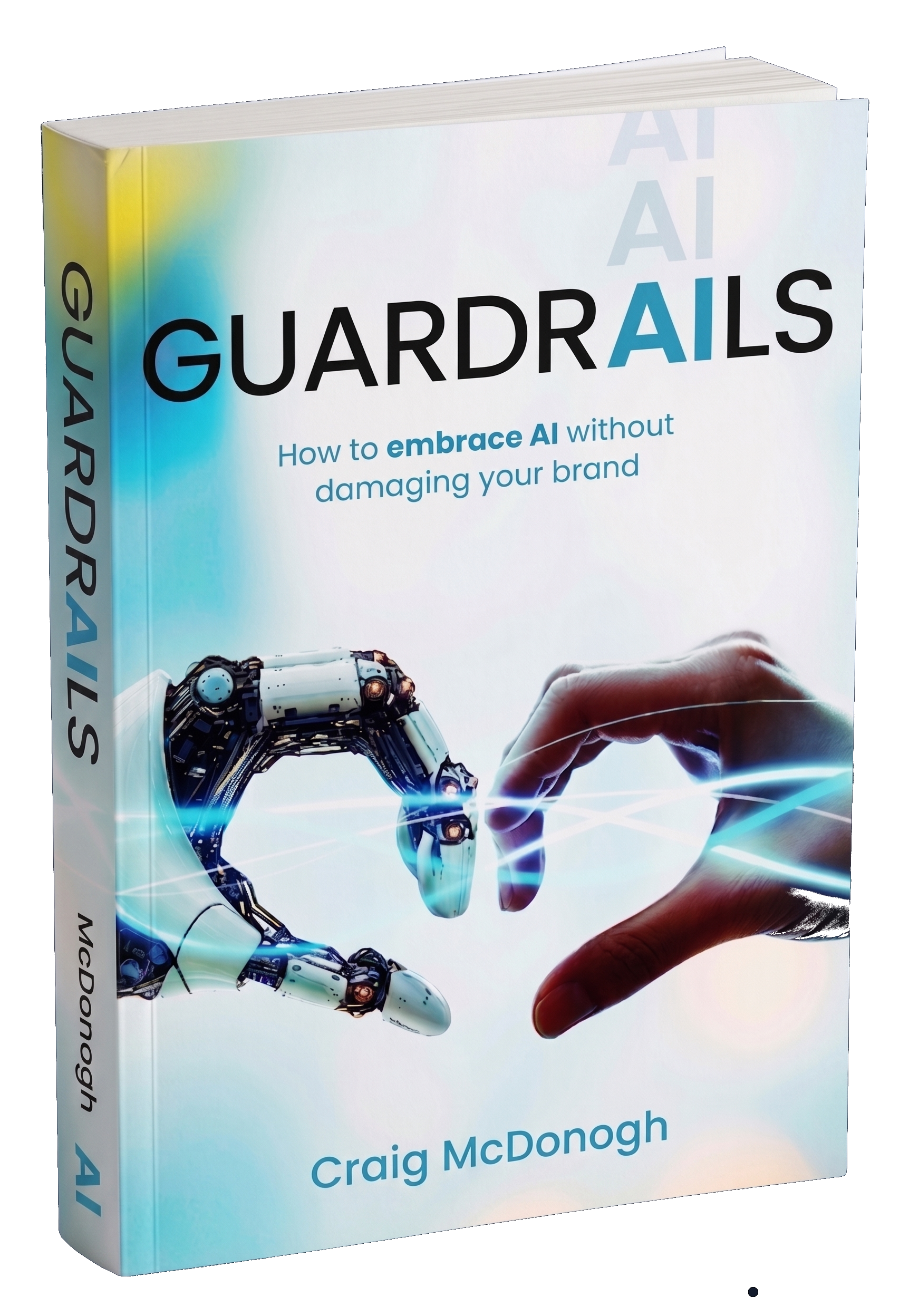
How to embrace AI in your business without damaging your brand
The practical guide for business leaders who want to move fast with AI — without the legal exposure, reputational landmines, or governance failures that come from moving without a plan.
The Core Argument
In the past year, you've probably sat through multiple presentations on "ethical AI." Someone showed you a slide deck full of vague, feel-good principles. Someone else handed you a legal brief that amounted to "don't do anything."
Guardrails is different. It shows you how the four principles of responsible AI - fairness, transparency, accountability, and human dignity - are not constraints on your AI ambitions. They are the foundation of sustainable competitive advantage.
Your competitors face a binary choice: deploy AI recklessly and risk spectacular public failure, or avoid AI entirely and fall behind. Guardrails shows you the third path - faster, bolder, and built to last.
You don't need to become a technical AI expert. You need to become an expert at managing AI's impact on your brand, your customers, and your organization. That's what this book is for.
"Ethical AI is actually a competitive advantage disguised as a design discipline."
— Introduction, GuardrailsThe Four Guardrails
These aren't abstract philosophy. They are the foundation of sustainable AI advantage - the difference between organizations that deploy AI boldly and safely, and those that deploy it and then explain themselves to regulators.
Your AI doesn't discriminate. Master this, and you can deploy AI in high-stakes contexts where your competitors are too scared to try - because one bias incident follows them into every boardroom for years.
People know when they're interacting with AI and can get meaningful explanations about how it affects them. Not "the algorithm said so" - actual clarity that builds, rather than erodes, trust over time.
A human being is responsible when AI fails. Not "the system." Not "the model." Not "the vendor said it would work." A named person with a job - which means problems get fixed rather than diffused.
Your customers aren't optimization problems. Your employees aren't productivity metrics. The AI that remembers this will outperform the AI that doesn't - in retention, in trust, and in long-term brand value.
The Risk Landscape
These seven pillars never operate independently - they compound. Your bias, transparency, and privacy strategies are interconnected. Your vendor accountability and IP exposure share common roots. Guardrails shows you how to address all seven, together.
Pillar 1
AI learns from data that reflects human bias. It becomes a brand crisis waiting to happen - particularly insidious because the AI isn't being intentionally discriminatory; it's simply very good at pattern-matching the wrong patterns.
Pillar 2
Nobody expects you to explain how email works. But everyone expects you to explain how your AI makes decisions about them - especially in credit, hiring, pricing, and customer service.
Pillar 3
AI challenges the fundamental question of whether your brand communications are genuinely from you. The question extends beyond content creation to customer insights, recommendations, and relationships.
Pillar 4
When your AI chatbot says something offensive, who is responsible? AI diffuses accountability in ways that complicate crisis management - everyone involved can reasonably claim they didn't fully understand the system.
Pillar 5
AI is hungry for data - and the more it has, the better it performs. The reputational risk emerges when customers realize their data is being used in ways they didn't anticipate, for purposes they didn't approve.
Pillar 6
When your AI generates marketing content, who owns it? What if it learned from copyrighted works during training? If you're using AI to generate content right now, you already have IP exposure - whether you know it or not.
Pillar 7
AI has a significant carbon footprint. If your company has made climate commitments, your AI adoption strategy may directly conflict with your sustainability goals - and climate-conscious stakeholders are increasingly asking questions.
Inside the Book
Guardrails is structured around the decisions real business and marketing teams actually face - not abstract ethical principles. Each section ends with a practical framework you can apply immediately.
Part One · Chapters 1–4
Why AI reputation risk is fundamentally different from every technology that came before - and how to map your organization's specific risk landscape before you need to manage a crisis.
Part Two · Chapters 5–9
How to build governance that actually works, manage AI-generated content without losing brand authenticity, and run the bias and fairness testing that protects you before a regulator or journalist does it for you.
Part Three · Chapters 10–12
AI incidents happen. This section covers early warning systems, the first 24-hour response playbook, and how to rebuild stakeholder trust after an AI-related brand failure ... without making a bad situation catastrophically worse.
Part Four · Chapters 13–15
The courage to say no to AI when it isn't the right tool. The emerging risks that will define the next five years. And a 90-day action plan to get your organization from where it is to where it needs to be.
A Tale of Two Approaches
The difference wasn't the AI. It was the approach. One organization optimized for speed and efficiency. The other optimized for speed, efficiency, and trust. Chapter 1 of Guardrails opens with this comparison because it captures everything that follows.
What happens without guardrails
Goldman Sachs & Apple - August 2019
Launched with sleek marketing: "Created by Apple, not a bank." The approach: deploy the technology quickly, explain it later. In November 2019, tech entrepreneur David Heinemeier Hansson tweeted that the algorithm had offered him a credit limit 20 times higher than his wife's - despite her having a better credit score. Apple co-founder Steve Wozniak confirmed the same happened to him.
The thread went viral. Within days, the New York Department of Financial Services opened a formal investigation. Customer service had no answers beyond "the algorithm decided." Goldman quietly raised both women's credit limits - which only raised an obvious question: if the algorithm was right, why the sudden reversal?
What happens with guardrails
Northwestern Medicine — 2024
Deploying generative AI across an 11-hospital network, Northwestern involved stakeholders from day one. Before deploying, they asked questions beyond technical performance: How will patients feel about AI reading their scans? What do radiologists need to trust the system? What happens when the AI is wrong?
They developed clear positioning: the AI is a tool to help radiologists, not replace them. Every scan is still reviewed by a human doctor. The AI often catches things humans miss, and humans catch things the AI misses. That's the point.
Who It's For
You don't need to be a technical AI expert. You need to be an expert at managing AI's impact on your brand, your customers, and your organization.
Who need to understand the board-level risk picture and make confident AI decisions without wading through legal briefs or technical manuals.
Who are accountable for AI strategy and need a practical framework for moving fast without creating the kind of reputational exposure that follows companies for years.
Who are evaluating, deploying, and renewing AI tools and need a rigorous vendor accountability framework and governance structure that actually holds.
Who need a marketing-fluent counterpart to work with, and want a shared vocabulary for AI risk that bridges the gap between legal caution and commercial ambition.
Free With the Book
Every section of Guardrails comes with a practical worksheet or template you can bring straight into your organization. Several are available free to download right now.
Part One Worksheet
A structured template for mapping every AI tool in your marketing stack - including data inputs, decision outputs, and vendor accountability gaps.
Available in the book →Part Two Worksheet
30 questions to ask before signing or renewing any AI marketing vendor contract. Covers model transparency, data use, bias testing, and contractual protections.
Available in the book →Part Three Worksheet
A step-by-step audit process for identifying demographic and proxy bias in AI-driven audience models, lookalike targeting, and lead scoring systems.
Available in the book →Part Five Worksheet
A ready-to-adapt governance framework template covering policy structure, decision rights, vendor oversight, regulatory mapping, and incident response.
Available in the book →Companion Tool
A structured self-assessment for identifying where your AI use creates brand, legal, and ethical exposure - before something goes wrong. Works as a standalone tool or as a companion to Guardrails.
Download Word Doc →Companion Tool
Twenty essential questions every marketing team should be able to answer before deploying an AI system - covering accountability, data governance, bias risk, and regulatory exposure.
Download PDF →Companion Tool
The questions you should be asking every AI vendor - before you sign, before you renew, and before you expand usage. Covers transparency, data practices, bias testing, and contractual accountability.
Download PDF →Want the tools now? Several are already available free on the resources page →
Early Praise
"In the AI era, brand, reputation, and governance are no longer side issues to innovation - they're central to it. Guardrails makes that case persuasively, and with rare practicality. Craig McDonogh gives marketers and business leaders a much-needed framework for embracing AI without losing authenticity, accountability, or stakeholder trust."
"Guardrails is an absolute must-read for leaders who understand that the viability of corporate life as we know it depends on vague ideas around 'ethical AI' evolving into clear, concrete, and actionable practices. Not only does Craig bring this evolution to life, he manages to convince even the most curmudgeonly of capitalists that practicing AI responsibly is not a 'cause' worth championing for the optics—quite the opposite. It's the ultimate competitive advantage for outsized commercial success, delivered at a critical tipping point where leaders must learn this lesson before they factor out the human ingenuity that stands between high margins and becoming a commodity. Those who read this book will stand out as the ones who remain on the right side of the line between the long-term growers and those who grind to a flatline. Get your copy…before it's too late."
"There is now a good case to be made that the future of AI rests on societal trust. In this sharp and helpful book, Craig McDonogh lays out the guardrails you need to protect your brand, your ability to innovate and compete, and ultimately, whether you survive."
Guardrails is available now. Leave your email below and we'll send you updates on new companion tools and resources as they're released.
No spam. Updates on new tools and resources only.